Soft robot legs that bend the right way
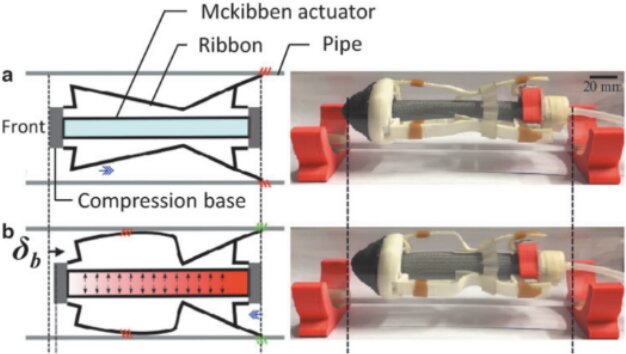
Robots that crawl inside pipes can inspect and repair them without digging them up. We studied a soft crawler design driven by a single air muscle, where each leg bends and buckles to grip the pipe wall more in one direction than the other, and asked how the leg's angle and small notches change that behavior.
The problem
The design we started from, by Lin et al., uses one pneumatic McKibben actuator (an air muscle that shortens when inflated). Its legs press against the pipe wall through rubber pads, and the robot moves because the legs slip forward more easily than backward.
That direction preference depends on details of the leg: its angle, its cross-section and where it buckles. Notches can steer buckling, but there is little theory saying a simple notch will reliably send it the right way. We wanted to characterize those details.
What we did
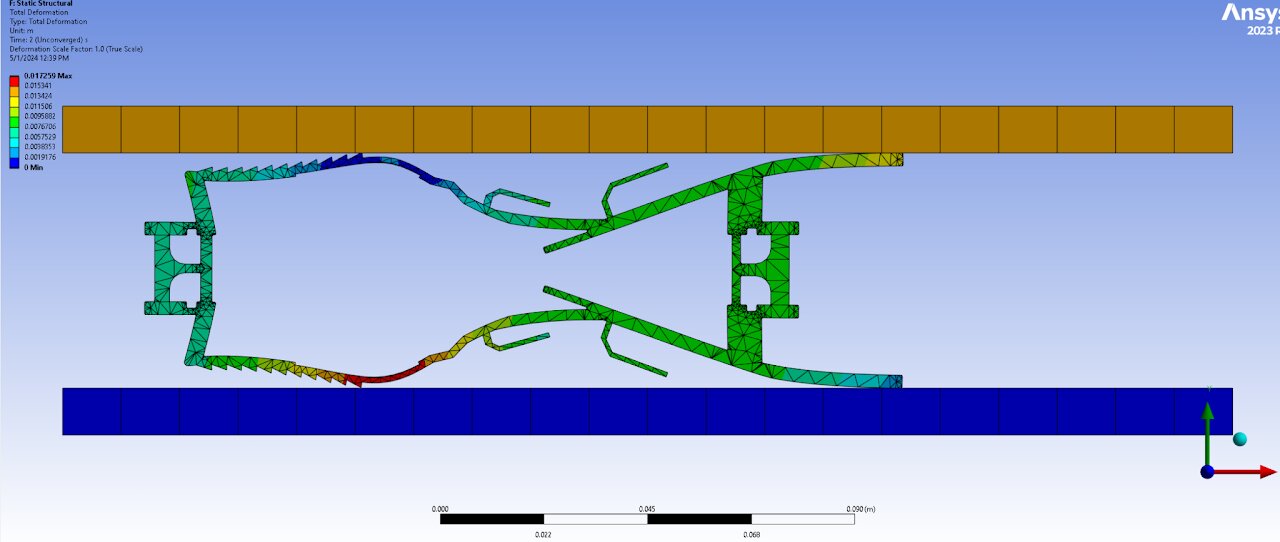
In Ansys, we simulated twelve leg variants: angles of 30, 40 and 54 degrees with a notch on the left, middle or right, plus the unmodified designs. We ran a static analysis, then an eigenvalue buckling analysis, then a second static run seeded with the buckled shape, which gives realistic large deformations. A second model squeezed each leg between two rigid beams standing in for the pipe walls.
For the physical side, our first PLA leg cracked under repeated bending, so we switched to Tough 1500 resin on a Form 4 printer (roughly 10-hour prints). We printed legs at 54, 40 and 30 degrees, plus two 30-degree legs with different notch positions, and cast silicone rubber feet in a 3D-printed mold.
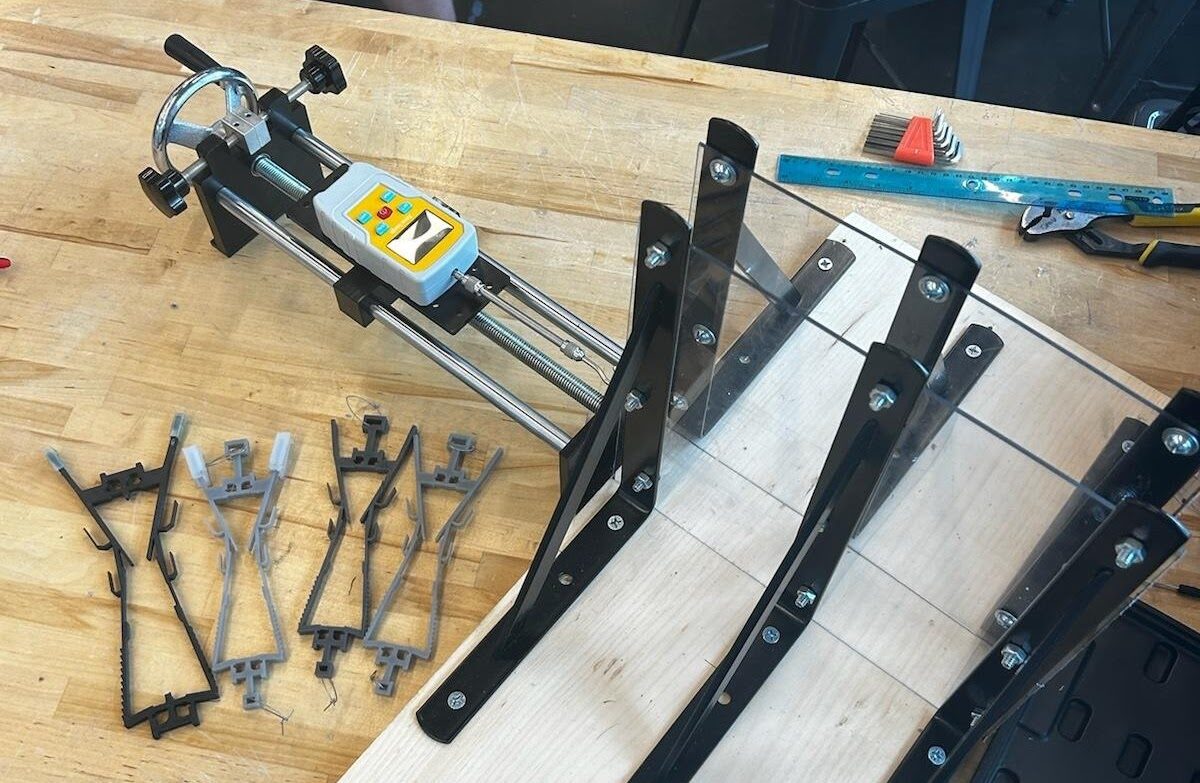
The test rig was a hand-crank platform with a digital force gauge. It pulled each leg between two acrylic sheets that acted as the pipe walls, and we recorded the forward and backward force needed to make the feet slip.
Results
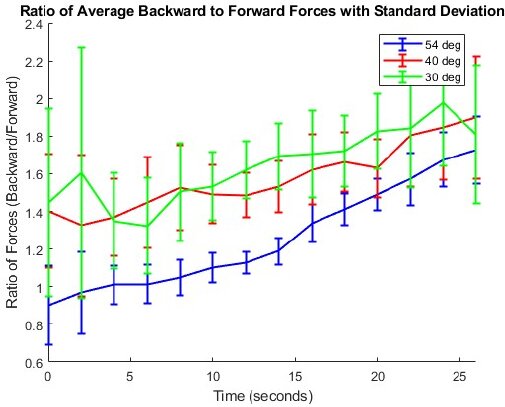
Steeper legs pushed harder on the walls, and simulated shear stress nearly doubled going from 30 or 40 degrees to 54. But the number that matters for crawling, the ratio of backward to forward force, favored the smaller angles. That was the opposite of what we expected.
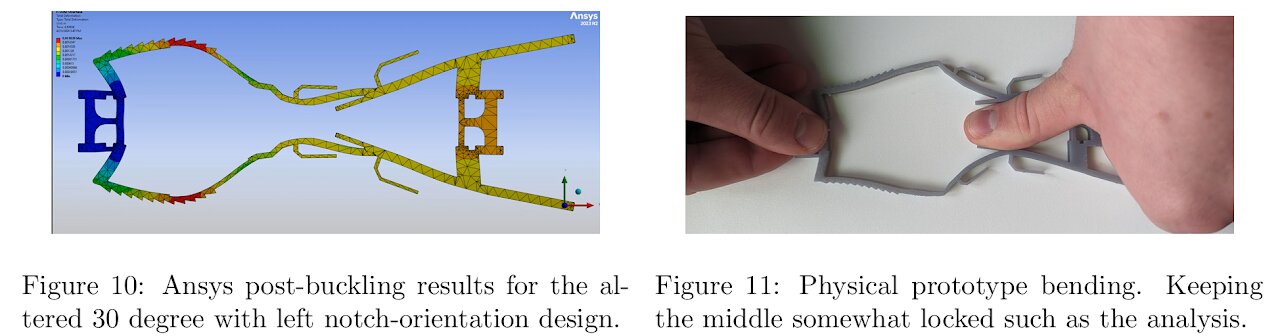
On buckling, a double-sided notch consistently produced one dominant buckling mode, which made behavior predictable, though not always in the direction we wanted. Most original designs buckled inward. Only the 30-degree leg with a left notch buckled outward, and only under extreme deformation.
We redesigned that leg with an extra notch to weaken its stiff ribbed section, and it then reliably buckled outward. A printed prototype matched the Ansys shape, and a combined squeeze-then-compress simulation showed it still buckled outward inside the pipe.
What I took away
Notches promote buckling, but a simple notch does not decide its direction on its own: the analysis found more than ten possible modes. Double-sided notches are what made the direction predictable.
Simulating first paid off, because each flexible print took about half a day. And our intuition about leg angle was wrong, which is exactly why the physical tests were worth doing.